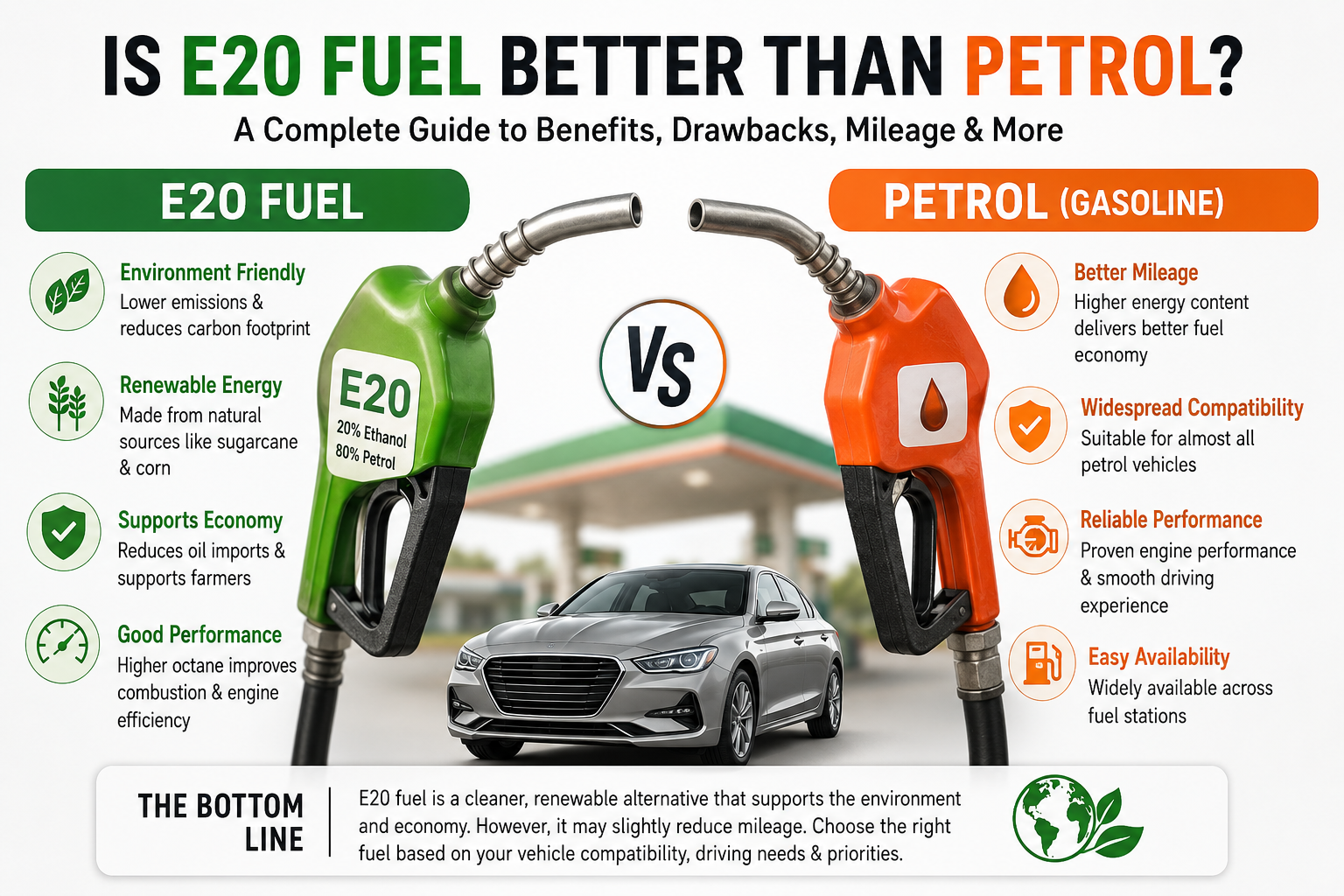
Is E20 Fuel Better Than Petrol
Introduction
With rising fuel prices and increasing concerns about environmental sustainability, many countries are adopting alternative fuel blends to reduce dependence on fossil fuels. One such fuel is E20 petrol, a blend containing 20% ethanol and 80% conventional petrol (gasoline). Governments and automobile manufacturers have been promoting E20 as a cleaner and more sustainable option, but many drivers still wonder: Is E20 fuel better than petrol?
The answer is not a simple yes or no. E20 offers several environmental and economic advantages, but it also has certain limitations that drivers should understand before using it. Whether E20 is better than regular petrol depends on factors such as your vehicle’s compatibility, driving habits, fuel efficiency expectations, and long-term maintenance considerations.
This detailed guide explains everything you need to know about E20 fuel, including how it works, its benefits and drawbacks, mileage differences, engine performance, costs, and whether switching to E20 makes sense for your vehicle.
Table of Contents
What Is E20 Fuel?
E20 fuel is a type of petrol blended with 20 percent ethanol and 80 percent conventional gasoline. Ethanol is an alcohol-based renewable fuel typically produced from agricultural crops such as sugarcane, corn, or other biomass materials.
Unlike pure petrol, which comes entirely from crude oil, E20 partially replaces fossil fuel with a renewable component. This helps reduce oil imports and lowers the carbon footprint associated with transportation.
Many countries have gradually increased ethanol blending percentages over the years. Earlier blends such as E5 or E10 contained only 5% or 10% ethanol. E20 represents the next step toward cleaner transportation while still allowing conventional petrol engines to operate with minimal modifications when designed for compatibility.
How Does E20 Fuel Work?
E20 functions similarly to ordinary petrol but contains ethanol molecules that burn differently inside the engine. Ethanol has a higher octane rating than gasoline, which can help improve combustion under certain conditions.
However, ethanol also contains less energy per litre than petrol. As a result, vehicles using E20 may consume slightly more fuel to travel the same distance compared to pure petrol.
Modern engines specifically calibrated for E20 can compensate for these differences through electronic fuel management systems, maintaining smooth performance while reducing certain emissions.
Understanding Regular Petrol
Regular petrol is refined from crude oil and has been the primary fuel for gasoline-powered vehicles for decades. It offers high energy density, making it efficient for long-distance travel and consistent engine performance.
Petrol is widely available, compatible with virtually all gasoline vehicles, and has well-established infrastructure for production and distribution. However, burning fossil fuels contributes significantly to greenhouse gas emissions and dependence on imported oil.
These environmental and energy security concerns are among the main reasons governments encourage ethanol blending.
Major Differences Between E20 Fuel and Petrol
Although E20 contains mostly petrol, the additional ethanol changes several important characteristics.
Composition
- Regular petrol: Nearly 100% gasoline.
- E20 fuel: 80% gasoline and 20% ethanol.
Source
Petrol is derived from crude oil, while ethanol is produced from renewable agricultural feedstocks.
Energy Content
Petrol contains more energy per litre than ethanol, meaning regular petrol generally provides slightly better fuel economy.
Environmental Impact
E20 often produces lower lifecycle carbon emissions because part of the fuel comes from renewable biomass instead of fossil fuels.
Engine Compatibility
Vehicles specifically designed or approved for E20 usually perform well, while some older vehicles may experience compatibility issues.
Is E20 Fuel Better Than Petrol?
The answer depends on what criteria you use to define “better.”
From an environmental perspective, E20 is generally better because it reduces fossil fuel consumption and supports renewable energy sources.
From a mileage perspective, conventional petrol usually performs slightly better because it contains more energy per litre.
From an economic standpoint, the answer varies depending on local fuel prices and vehicle efficiency.
For drivers using E20-compatible vehicles, the differences in everyday driving may be relatively small. However, owners of older vehicles should follow manufacturer recommendations before switching fuels.
Environmental Benefits of E20 Fuel
One of the strongest arguments in favor of E20 is its positive environmental impact.
Reduced Carbon Emissions
Because ethanol originates from plants that absorb carbon dioxide during growth, its overall lifecycle emissions can be lower than fossil fuels.
Lower Dependence on Oil
Blending ethanol reduces the amount of crude oil needed for transportation fuels, helping countries decrease oil imports and improve energy security.
Renewable Resource
Unlike petroleum, which takes millions of years to form, ethanol can be produced annually from agricultural crops.
Cleaner Combustion
Ethanol contains oxygen, promoting more complete combustion and potentially reducing certain pollutants emitted from vehicle exhaust systems.
Advantages of Using E20 Fuel
Supports Sustainable Energy
E20 encourages the use of renewable resources instead of relying entirely on finite fossil fuels.
Helps Farmers and Agriculture
In many countries, ethanol production creates additional demand for crops such as sugarcane and corn, benefiting agricultural sectors.
Potential for Improved Octane Rating
Ethanol naturally has a high octane value, which may help reduce engine knocking in appropriately designed engines.
Government Support
Many governments actively promote ethanol blending through policy initiatives aimed at reducing emissions and improving fuel security.
Compatible with Many New Vehicles
Modern vehicles designed or certified for E20 generally operate effectively without requiring significant changes in driving habits.
Disadvantages of E20 Fuel
Slightly Lower Mileage
Because ethanol contains less energy than petrol, fuel economy may decrease modestly compared to conventional gasoline.
Compatibility Concerns
Older engines and certain fuel system components may not be designed to handle higher ethanol concentrations.
Moisture Absorption
Ethanol absorbs water more readily than gasoline, making proper fuel handling and storage important.
Potential Material Wear
Some older rubber seals, hoses, and plastic components may degrade faster when exposed to higher ethanol blends.
Does E20 Affect Vehicle Mileage?
Yes, E20 can reduce fuel economy slightly.
Since ethanol provides fewer energy units per litre than petrol, engines generally need a little more fuel to produce the same amount of power.
In practical terms, many drivers may notice only a small reduction in mileage, often depending on vehicle design, driving conditions, and engine calibration.
Vehicles specifically engineered for E20 may minimize these differences through optimized engine management systems.
Does E20 Improve Engine Performance?
Performance effects vary.
Modern E20-compatible engines often maintain smooth acceleration and normal power delivery. In some cases, ethanol’s higher octane rating can improve combustion characteristics.
However, if a vehicle is not designed for E20, performance issues such as rough idling, harder starting, or reduced efficiency could occur.
Following manufacturer recommendations remains the safest approach.
Is E20 Safe for All Cars?
No.
Many recently manufactured vehicles are approved for E20 use, but some older models were designed only for lower ethanol blends.
Before filling up with E20, owners should:
- Read the vehicle owner’s manual.
- Check manufacturer fuel recommendations.
- Confirm whether the engine and fuel system are certified for E20 operation.
Using incompatible fuel could potentially increase wear or affect reliability over time.
Cost Considerations
Whether E20 saves money depends on regional fuel pricing.
If E20 costs significantly less than regular petrol, any slight reduction in mileage may be offset by lower purchase prices.
Conversely, if prices are similar, drivers focused purely on maximizing distance per litre may prefer conventional petrol.
The overall financial impact often depends more on local market conditions than on the fuel itself.
E20 and Long-Term Engine Health
Extensive testing by manufacturers and regulatory agencies suggests that vehicles designed for E20 can operate safely over long periods.
Properly engineered fuel systems use ethanol-resistant materials and engine calibrations that account for the blend’s characteristics.
Problems are more likely to arise when older vehicles not intended for E20 repeatedly use higher ethanol concentrations without manufacturer approval.
Routine maintenance remains important regardless of fuel type.
Impact on Cold Weather Starting
Ethanol vaporizes differently from gasoline, which can sometimes affect cold starts under low-temperature conditions.
Manufacturers account for these factors when designing E20-compatible engines. In most everyday situations, drivers should notice little difference.
Extreme climates may require specialized calibrations or seasonal fuel adjustments depending on local regulations.
E20 Fuel and Motorcycles
Not all motorcycles are approved for E20 use.
Smaller engines, older fuel systems, and carbureted motorcycles may be more sensitive to ethanol content.
Motorcycle owners should always verify compatibility with the manufacturer before switching fuels.
E20 in Hybrid Vehicles
Many hybrid vehicles can use E20 if approved by their manufacturers.
Since hybrids frequently adjust engine operation electronically, compatibility depends on factory specifications rather than hybrid technology itself.
Always follow official recommendations provided for your specific model.
Who Should Consider Using E20?
E20 may be a suitable choice for:
- Drivers of vehicles certified for E20.
- Environmentally conscious motorists.
- Regions promoting renewable fuels.
- Owners whose manufacturers explicitly recommend or permit E20.
Who Should Continue Using Regular Petrol?
Regular petrol may remain the better choice for:
- Older vehicles without E20 approval.
- Classic or collector cars.
- Engines with sensitive fuel systems.
- Owners uncertain about compatibility.
Practical Tips Before Switching to E20
Verify Compatibility
Always consult your owner’s manual or dealership before using E20.
Observe Vehicle Behavior
If switching fuels, monitor mileage, starting behavior, and engine performance.
Keep Up with Maintenance
Replace filters and follow scheduled servicing recommendations.
Buy Fuel from Reliable Stations
High-quality fuel handling reduces contamination risks and helps maintain consistent performance.
Common Myths About E20 Fuel
Myth 1: E20 Damages Every Engine
False. Many modern vehicles are specifically engineered to use E20 safely.
Myth 2: E20 Always Gives Better Mileage
False. Because ethanol contains less energy, mileage is often slightly lower.
Myth 3: E20 Produces More Power
Not necessarily. Engine calibration determines actual performance more than fuel blend alone.
Myth 4: Ethanol Is Harmful to All Fuel Systems
Modern ethanol-compatible materials are designed to withstand E20 exposure.
Myth 5: E20 Completely Eliminates Emissions
No fuel is emission-free. E20 can reduce certain emissions but still produces exhaust gases during combustion.
Future of E20 Fuel
As governments pursue cleaner transportation and energy independence, ethanol-blended fuels are likely to become increasingly common.
Automobile manufacturers continue developing engines optimized for higher ethanol blends, while agricultural and energy sectors expand production capabilities.
Although electric vehicles are gaining popularity, E20 may serve as an important transitional fuel by lowering emissions from existing internal combustion engines.
Conclusion
So, is E20 fuel better than petrol? The answer depends on your priorities and your vehicle.
If your car is designed to use E20, the fuel offers meaningful environmental benefits, supports renewable energy initiatives, and can operate effectively with only a modest reduction in fuel economy. It contributes to lower fossil fuel dependence and may help reduce certain emissions.
However, conventional petrol still provides slightly higher energy content and may deliver better mileage. Older vehicles that are not certified for E20 should continue using manufacturer-recommended fuels to avoid potential compatibility issues.
For most drivers, the smartest decision is to follow the vehicle manufacturer’s guidance rather than assuming one fuel is universally superior. When used in compatible vehicles, E20 represents a practical step toward more sustainable transportation without dramatically changing the driving experience.
Frequently Asked Questions (FAQs)
1. Is E20 fuel better than normal petrol?
E20 is generally better from an environmental perspective because it contains renewable ethanol, but regular petrol usually provides slightly better mileage due to its higher energy content.
2. Can every petrol car use E20 fuel?
No. Only vehicles approved or designed for E20 should regularly use it. Owners should check their manufacturer’s recommendations before switching.
3. Does E20 reduce mileage?
Yes, E20 may reduce fuel economy slightly because ethanol contains less energy per litre than conventional petrol.
4. Will E20 damage my engine?
In vehicles specifically designed or certified for E20, it should not cause damage when used as intended. Compatibility is the key factor.
5. Is E20 more environmentally friendly?
Generally, yes. E20 reduces reliance on fossil fuels and incorporates renewable ethanol, which can lower lifecycle carbon emissions.
6. Should I switch from petrol to E20?
If your vehicle manufacturer approves E20 use, switching can be a reasonable choice. If your vehicle is not compatible, continue using the recommended fuel grade.
About the Author