dara singh age
Introduction: dara singh age
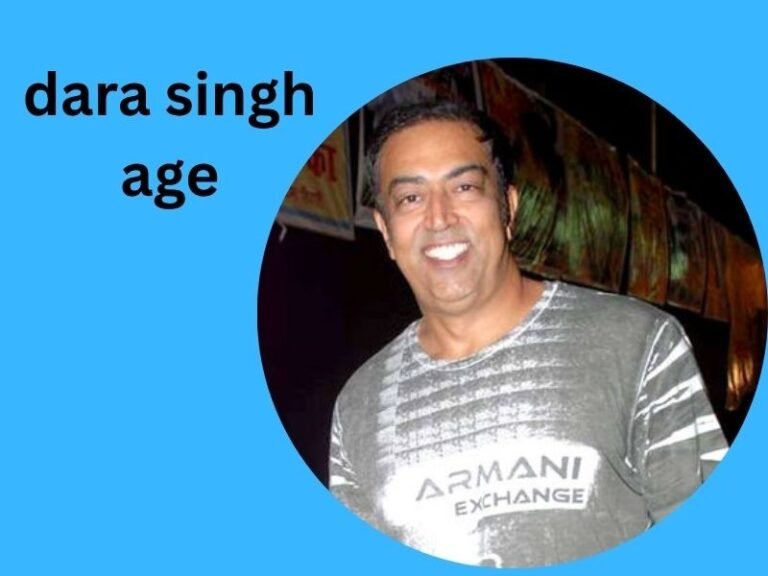
Dara Singh, born Deedar Singh Randhawa, was an Indian professional wrestler, film actor, director, writer and politician, remembered as one of the strongest and most recognisable sporting figures in the country’s history. Anyone searching for Dara Singh’s age is usually surprised to learn that he is no longer alive. He was born on 19 November 1928 and died on 12 July 2012 in Mumbai at the age of 83. Had he lived, he would be 97 years old today, and he would turn 98 on 19 November 2026. His life ran across nearly the whole of the twentieth century and into the twenty-first, from a farming village in colonial Punjab to the wrestling rings of Southeast Asia, the film studios of Bombay, a beloved television role as Hanuman, and a seat in India’s Rajya Sabha.
This article covers Dara Singh’s age, early life, wrestling and film careers, achievements, personal life and the question of his net worth. Where a detail is not reliably documented, the article says so instead of guessing. That matters especially for money, since many websites publish confident-looking numbers that no one can verify.
Dara Singh Wiki Bio Table
| Attribute | Details |
|---|---|
| Full Name | Dara Singh Randhawa |
| Birth Name | Deedar Singh Randhawa |
| Popular Name | Dara Singh |
| Profession | Professional wrestler, actor, director, producer, writer, politician |
| Date of Birth | 19 November 1928 |
| Birthplace | Dharmuchak village, Amritsar district, Punjab, British India |
| Date of Death | 12 July 2012 |
| Place of Death | Mumbai, Maharashtra, India |
| Age at Death | 83 years |
| Age if Alive Today | 97 years (turning 98 on 19 November 2026) |
| Zodiac Sign | Scorpio |
| Nationality | Indian |
| Religion | Sikhism |
| Hometown | Amritsar, Punjab |
| Education | Limited formal schooling; details not publicly disclosed |
| Height | Approximately 6 ft 2 in (about 188 cm), as commonly reported |
| Weight | Not publicly disclosed |
| Eye Colour | Not publicly disclosed |
| Hair Colour | Not publicly disclosed |
| Father | Surat Singh Randhawa |
| Mother | Balwant Kaur |
| Siblings | Brother Sardara Singh Randhawa (wrestler) |
| Spouses | Bachno Kaur (first wife), Surjit Kaur (second wife) |
| Children | Parduman Singh Randhawa, Vindu Dara Singh (actor), among others; the full number is not consistently documented |
| Wrestling Titles | Rustam-e-Punjab, Rustam-e-Hind; Commonwealth championship (1959, as widely reported) |
| Wrestling Retirement | 1983 |
| Film Debut | Sangdil (1952) |
| Best-Known TV Role | Hanuman in Ramayan (1987-88) |
| Political Career | Nominated member of the Rajya Sabha (2003-2009) |
| Autobiography | Meri Atmakatha (in Punjabi) |
| Net Worth | Not publicly disclosed; online figures are unverified estimates |
| Social Media | No verified personal accounts from his lifetime |
Table of Contents
Dara Singh Age and Date of Birth
Dara Singh was born on 19 November 1928 in the village of Dharmuchak in the Amritsar district of Punjab, then part of British India. His date of birth is widely documented in biographical reference works and in the news coverage that followed his death. He died on 12 July 2012, so his age at death was 83 years. People often ask about “Dara Singh’s current age” because he stayed in public memory for decades, especially through the 1980s television era. The accurate answer is that he passed away in 2012, and any age quoted for a living Dara Singh is really a calculation of how old he would have been.
His full name was Dara Singh Randhawa. He was born Deedar Singh, but the name Dara became his identity, first in wrestling circles and then across the country. Randhawa is the family’s Jat Sikh surname, and it was shared by his brothers, who also took up wrestling. His younger brother Sardara Singh Randhawa, known in the ring as Randhawa, wrestled alongside him and became a well-known tag partner and opponent in the exhibition matches that made the family famous.
Early Life and Education
Dara Singh grew up in rural Punjab in a farming family. His father was Surat Singh Randhawa and his mother was Balwant Kaur. Village life in that era was physically demanding, and wrestling, known locally as kushti or pehlwani, was a common pastime and a respected tradition. Akharas, the mud pits where young men trained, were social centres as much as sports venues. Dara Singh took to this culture early, and his sturdy build made him stand out among boys his age.
Formal schooling was brief by modern standards. Like many rural boys of the time, he received limited education before the pull of the akhara and the demands of farm work took over. His real education came through discipline, diet and daily practice. Accounts of his youth describe a routine built around exercise, a milk-and-ghee-heavy diet typical of Punjabi wrestlers, and long hours in the pit. His family encouraged his interest, and his strength soon earned him a reputation in neighbouring villages. Details of his schooling are not extensively documented, so it is best to say that his formal education was modest and that wrestling shaped his early adulthood.
He also married young, as was customary at the time. That part of his story is covered in the personal life section below.
Career Journey
The Wrestler Who Went Abroad
Dara Singh’s wrestling career began in the villages of Punjab, but it grew internationally after he travelled to Singapore in the late 1940s. He worked there and began competing in professional wrestling, which was then popular across Southeast Asia. Singapore and Malaysia became his proving ground. Standing well over six feet and carrying a heavy, muscular frame, he had an imposing presence, and his Indian wrestling background gave him stamina and technique that impressed promoters and audiences.
His fame spread through a series of high-profile bouts against international opponents. He wrestled in several countries, and his matches were covered by newspapers in India, where audiences followed his victories with great pride. For many Indians in the 1950s and 1960s, newly independent and eager for heroes who could stand toe to toe with the world, Dara Singh was a symbol of national strength.
Titles and Famous Bouts
Among the most cited achievements of his wrestling life are the titles of Rustam-e-Punjab and Rustam-e-Hind, honours rooted in the Indian wrestling tradition. In 1959 he is widely reported to have won the Commonwealth wrestling championship in Calcutta (now Kolkata), defeating the Australian George Gardiner. The most celebrated moment of his career came in 1968, when he is credited with defeating the American wrestler Lou Thesz, a former world champion, in Bombay (now Mumbai), which led to his recognition as world heavyweight champion in the professional circuit that recognised the title. Thesz was a legendary figure in the sport, so the win became a landmark in Indian sports history.
Dara Singh also became famous for his matches against the Hungarian-born wrestler Emil Czaja, known as King Kong, and against many other touring opponents. These bouts were often large public events, drawing big crowds. He retired from professional wrestling in 1983, and a frequently repeated claim is that he did so unbeaten after hundreds of professional matches. Because wrestling record-keeping from that era is informal and varies by source, the exact number of bouts and the “undefeated” claim are best treated as widely reported rather than precisely audited.
Entry into Films
Wrestling fame opened the door to cinema. His film debut is generally dated to the early 1950s, with a small role in Sangdil (1952). The real breakthrough came in the late 1950s and 1960s, when producers recognised that his physique and popularity could sell tickets. He became the leading man in a wave of action and stunt films, a genre in which strength and spectacle mattered more than dialogue. Titles such as Faulad, King Kong and several Tarzan- and Hercules-style adventures made him a star of the B-movie circuit that drew huge audiences in small towns and cities.
He frequently starred opposite the actress Mumtaz in these films, and the pairing became one of the most recognisable on-screen duos of that action cycle. Their films did well commercially and helped establish Mumtaz before she went on to mainstream stardom. Dara Singh’s screen image was that of an honest, powerful and morally upright hero, which fit well with the public’s perception of him as a sportsman.
Directing, Writing and Producing
Dara Singh did not limit himself to acting. He directed and produced films, including Punjabi-language cinema, and he wrote. His directorial work includes the 1970s Punjabi film Nanak Dukhiya Sab Sansar, and he was involved in making films that reflected his Punjabi roots. He also wrote an autobiography in Punjabi, Meri Atmakatha, which gives his own account of his life. He is also associated with film infrastructure in Punjab, including a studio complex bearing his name near Mohali, which reflects his interest in building up regional cinema.
The Character Roles and the Hanuman Era
As his leading-man years wound down, Dara Singh transitioned smoothly into character roles. He played fathers, patriarchs and strongmen in mainstream Hindi cinema. In Manmohan Desai’s Mard (1985), he appeared as the father of Amitabh Bachchan’s character, a role that introduced him to a new generation of viewers.
His most beloved role, however, came on television. In Ramanand Sagar’s epic series Ramayan, which aired in 1987 and 1988 and became one of the most-watched television programmes in India, Dara Singh played Hanuman. His towering build, gentle humour and devotional sincerity made the portrayal iconic. For many Indians who grew up in the late 1980s, he was Hanuman. He reprised the role in the television adaptation of the Mahabharat and in other mythological productions, and the association with the character endured for the rest of his life.
Later in his career he continued to take on supporting parts. One of the best-known is his appearance in Jab We Met (2007), in which he played the grandfather of Kareena Kapoor’s character. It was a warm, affectionate role that showed his appeal had not faded even in his late seventies.
Politics
In 2003, Dara Singh was nominated to the Rajya Sabha, the upper house of India’s Parliament, and served until 2009. He was reported to be the first sportsperson nominated to the house. His nomination reflected his stature as a national figure and was associated with the Bharatiya Janata Party, which was in government at the time. He also took part in public and community activities, and his political role was largely a recognition of his celebrity rather than a long career in party politics.
Major Achievements and Awards
Dara Singh’s achievements span sport, entertainment and public life. In wrestling, he is remembered for the Rustam-e-Punjab and Rustam-e-Hind titles, for the Commonwealth championship win reported in 1959, and for the 1968 victory over Lou Thesz that led to his recognition as a world champion in the professional circuit. His retirement in 1983 closed a career that lasted more than three decades and covered numerous countries.
In entertainment, his reputation rests on the dozens of films in which he acted, and on his role as Hanuman in Ramayan, which made him a household name beyond cinema audiences. He also built a record as a director, producer and writer, which is unusual for a man who first became famous through sport. His nomination to the Rajya Sabha was a mark of national recognition as well.
When it comes to formal government awards and trophies, readers should be careful with the long lists found online. Many of these lists mix verified honours with unsourced claims. The achievements named here are the ones most consistently documented. For a complete and verified list of every award, citation and honorary title, it is best to consult official sources or authoritative biographical records. He remains widely honoured in memory, and his legacy is commemorated in sporting and cultural circles in Punjab and across India.
Net Worth
Dara Singh’s net worth is not publicly disclosed in any verified, authoritative form. He died in 2012, and no audited statement, official estate valuation or reliable financial disclosure has been made public. Several websites publish net worth figures for him, but these are estimates, they vary significantly from source to source, and their methods are not transparent. For that reason, this article does not repeat any specific number. Treat any figure you see online as an unverified estimate rather than an exact fact.
What can be said responsibly concerns his income sources. Over his career he earned through professional wrestling bouts and exhibitions, which were commercially significant in an era when marquee matches drew large paying crowds. He earned as a film actor, director and producer across decades, and he took television roles, with his Ramayan work among the best known. He also received the salary and allowances associated with his period as a member of the Rajya Sabha, as with any parliamentarian. He was associated with studio and film infrastructure in Punjab, which suggests business interests beyond acting, though the details and valuation of those interests are not publicly documented.
As for lifestyle, he lived for many years in Mumbai, and his death took place at his home there. Beyond that, specifics about property, assets or investments are not publicly disclosed, and it would be inappropriate to speculate. The honest summary is that he was financially successful by the standards of his time and field, but the actual figure of his wealth is not known.
Physical Appearance
Dara Singh’s physical presence was central to his fame. He is commonly reported to have stood around six feet two inches (roughly 188 cm), with a powerful, heavily muscled build typical of a heavyweight wrestler. This height is repeated across many sources, but it comes from reference compilations and press accounts rather than an official measurement, so it should be treated as approximate. His weight is not reliably documented, and various figures circulate online, so it is best described as not publicly disclosed. His eye colour and hair colour are likewise not publicly disclosed in any verified source, and the photographs and films that survive from different decades show only how his appearance changed with age. What is clear from the historical record is that his physique was a defining part of his public image, which made him a natural fit for both the wrestling ring and the roles of Hanuman and other mighty figures.
Personal Life
Dara Singh married young, in keeping with the custom of his village and era. His first wife was Bachno Kaur, and the marriage was arranged by his family. They had a son, Parduman Singh Randhawa. Later in life, he married Surjit Kaur, his second wife, and they had children together. His best-known child is the actor Vindu Dara Singh, who followed him into the entertainment industry and became familiar to television audiences as a performer and as the winner of the reality show Bigg Boss in its third season. The total number of Dara Singh’s children and the details of every family member’s life are not consistently documented across sources, and private matters are best left to the family to share.
His brother Randhawa was a wrestler who often appeared with him, and the sporting tradition continued in the family to a degree. Dara Singh was known as a family man with deep roots in Punjabi culture and in the Sikh faith, and he remained attached to his village origins even after years in Mumbai. Beyond these widely reported facts, intimate details of his relationships have not been made public in verified form, and this article does not speculate.
Dara Singh died on 12 July 2012 at his home in Mumbai, following a period of serious illness that included a heart attack and hospital treatment. His death was widely reported as a major loss for Indian sport and cinema. Tributes came from the film industry, political leaders and fans across the country.
Social Media Presence
Dara Singh’s career peaked well before the age of social media, and he died in 2012 when platforms such as Instagram and X were still in their early stages in India. There is no verified, official personal account run by him that is known to have been maintained during his lifetime, so there is no meaningful follower count to report. His memory is kept alive today through fan pages, film retrospectives, clips of Ramayan shared online, and posts by family members, particularly his son Vindu Dara Singh, who is active on social platforms. If you come across accounts using his name, treat them as tribute or fan pages unless they are clearly verified, and remember that follower counts for any such page change constantly and cannot be treated as fixed numbers.
Interesting Facts
Dara Singh’s life is full of details that capture how large a figure he was in India’s popular imagination. He is often described as the first sportsperson to be nominated to the Rajya Sabha, which says something about the public stature he reached beyond the ring. His pairing with Mumtaz in action films of the 1960s is still a talking point among classic cinema fans, and those films are remembered as some of the most successful of the stunt-film genre.
The role that defined his later image, Hanuman in Ramayan, was a perfect match of actor and character. Audiences in the late 1980s so strongly associated him with the devoted monkey god that many people continued to address him with reverence in public. The series itself was a national television phenomenon, and the character’s popularity helped keep Dara Singh visible long after his wrestling days had ended.
He also wrote his own life story, and the fact that a man known primarily for strength chose to put his memories on paper reflects a thoughtful side that his screen persona rarely showed. His brother Randhawa’s wrestling career, his Punjabi film production work and his interest in studio-building all show a man who tried to give back to the regional culture that raised him. And although the full details of his bout record are difficult to verify, the reputation he built has remained remarkably durable for more than a decade after his death.
FAQs
What is Dara Singh’s age?
Dara Singh was born on 19 November 1928 and died on 12 July 2012, at the age of 83. If he were alive today, in October 2026, he would be 97 years old, turning 98 on 19 November 2026.
Where was Dara Singh born?
He was born in the village of Dharmuchak in the Amritsar district of Punjab, then part of British India. His birth name was Deedar Singh Randhawa.
What was Dara Singh known for?
He was known as a champion wrestler, a film actor, director and writer, and a politician. Many viewers remember him best for playing Hanuman in the television series Ramayan in 1987 and 1988, while sports fans remember his professional wrestling titles and his 1968 win over Lou Thesz.
What is Dara Singh’s net worth?
His net worth is not publicly disclosed. No verified or official figure exists, and the numbers on various websites are unverified estimates that differ widely. His income came from wrestling, films, television, production work and his time as a member of the Rajya Sabha.
Who are Dara Singh’s family members?
His first wife was Bachno Kaur, with whom he had a son, Parduman Singh Randhawa. His second wife was Surjit Kaur. His son Vindu Dara Singh is an actor and a former Bigg Boss winner. His brother Randhawa was also a wrestler. Other personal details are not comprehensively documented.
How did Dara Singh die?
He died on 12 July 2012 at his home in Mumbai, after a serious illness that followed a heart attack and hospital treatment. He was 83.
Was Dara Singh really undefeated?
It is widely reported that he retired in 1983 without a professional defeat after hundreds of bouts. Because wrestling records from that era were maintained informally and vary by source, the claim is best described as widely reported rather than independently confirmed.
Conclusion
Dara Singh’s journey is the story of a village wrestler from Punjab who became a national icon. He left home for Singapore, earned titles in the ring, defeated international names, and then carried his fame into cinema, where he became a star of action films and later a respected character actor. His role as Hanuman gave him a place in the hearts of millions, and his nomination to the Rajya Sabha showed that the country saw him as more than an entertainer. Questions about his age lead to a simple answer, 83 years at the time of his death in 2012, while questions about his net worth lead to an honest one: it has never been publicly disclosed. What is certain is that his strength, humility and warmth left a lasting mark on Indian sport and screen, and that his name still stands for courage and fair play.
About the Author