train manager salary
If you’ve been researching government jobs in India, chances are the phrase “train manager salary” has popped up in your search results more than once. And it’s easy to see why. The role of Train Manager — the position that replaced the old designation of Railway Guard — is one of the most sought-after jobs in Indian Railways. It offers a stable government paycheck, a respectable pay scale, and a career path that keeps improving over time.
But what does a Train Manager actually earn? Is it just the basic pay you see on paper, or is there more to the number once allowances and perks are added in? And how does someone even become a Train Manager in the first place? This guide walks through all of it in plain language, so whether you’re a student exploring career options, a job aspirant preparing for the RRB NTPC exam, or simply someone curious about how railway salaries work, you’ll come away with a clear picture.
Table of Contents
Who Is a Train Manager, Exactly?
Before diving into numbers, it helps to understand what the job actually involves. A Train Manager is the railway official responsible for the safe and smooth running of a train from departure to arrival. This person coordinates with the loco pilot (the train driver), the station master, and the control room to make sure the train moves on schedule and handles any emergencies that come up along the way.
Historically, this job was known as “Guard,” and many people — especially parents and relatives of job aspirants — still use that older term. Indian Railways rebranded the post to Train Manager a few years back to better reflect the responsibility involved, since the role is far more than just riding along in the last coach with a whistle and a flag.
There are a few flavors of this job depending on what kind of train someone is assigned to:
- Passenger Train Manager – handles passenger trains, coordinates with the crew, oversees onboard safety, and deals with passenger-related issues during the journey.
- Goods Train Manager – responsible for freight trains, which involves coordinating loading and unloading, tracking consignments, and maintaining records for goods movement.
- Senior/Chief Train Manager – a more senior designation that comes with experience and departmental promotions.
Regardless of which category someone falls into, the day-to-day nature of the job is similar: constant coordination, alertness, and a fair bit of responsibility for passenger and cargo safety.
Train Manager Salary: The Basic Pay Structure
Here’s where most job aspirants want to jump straight to — the actual number. The salary of a Train Manager in Indian Railways is governed by the 7th Central Pay Commission (CPC), which standardizes government salaries across different job levels.
A Train Manager’s post generally falls under Pay Level 5 of the pay matrix, while more senior or specialized categories, such as Senior or Passenger Train Manager, can be placed at Pay Level 6. Here’s what that looks like in practice:
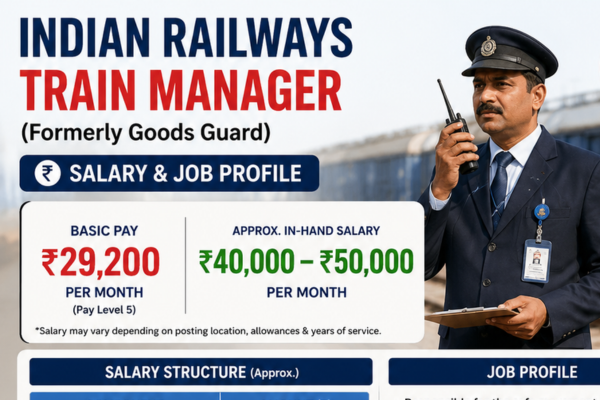
- Basic Pay: Starts at around ₹29,200 per month for freshers entering the post.
- Pay Matrix Range: The full range for Level 5 stretches up to roughly ₹92,300, which reflects the various stages of the pay scale a person moves through over a long career with periodic increments.
It’s worth remembering that the basic pay is just the starting point. Government salaries are almost never just the basic figure — they’re built up through a combination of basic pay plus several allowances, which is where things get more interesting.
How Basic Pay Turns Into In-Hand Salary
A lot of people get confused when they see the basic pay figure and then hear that Train Managers “actually earn much more.” That’s because the in-hand salary — the amount that actually lands in a Train Manager’s bank account — includes several add-ons layered on top of the basic pay.
For a fresh recruit, the typical in-hand salary after all standard deductions (like provident fund contributions) usually falls somewhere in the range of ₹40,000 to ₹50,000 per month. Some sources place the figure closer to ₹45,000 once all allowances are factored in, while others suggest it can comfortably sit in the ₹50,000 to ₹60,000 range depending on posting location and applicable allowances.
Where things get even more attractive is when overtime, running allowances (a special allowance for railway staff who work directly on running trains), and night duty pay are added. Many working Train Managers, once these extra components are included, report monthly earnings anywhere between ₹65,000 and ₹80,000. That’s a meaningful jump from the basic pay figure and one reason the job remains popular despite the demanding schedule.
Breaking Down the Allowances
Government salaries are famous for their alphabet soup of allowances, and the Train Manager pay package is no exception. Understanding these components helps explain why the gross salary looks so different from the basic pay.
Dearness Allowance (DA)
This is a cost-of-living adjustment that the government revises periodically to help offset inflation. It’s calculated as a percentage of the basic pay and is one of the biggest contributors to the overall salary bump.
House Rent Allowance (HRA)
HRA depends on where a Train Manager is posted. Indian Railways classifies cities into X, Y, and Z categories for this purpose — someone posted in a major metro city gets a higher HRA percentage than someone posted in a smaller town. That said, employees in smaller towns often get access to railway quarters or subsidized housing, which can offset the lower HRA to some extent.
Transport Allowance (TA)
This covers commuting costs and, like HRA, varies slightly depending on the city classification of the posting.
Night Duty and Running Allowances
Because trains operate around the clock, Train Managers frequently work night shifts and irregular hours. Night duty allowance compensates for this, and running staff (employees who are actually on board moving trains, as opposed to desk-based railway staff) receive an additional running allowance, which can meaningfully boost monthly earnings.
Other Perks and Benefits
Beyond the cash components, the job comes with several non-monetary benefits that are worth factoring into any honest comparison with private-sector jobs:
- Free or concessional railway passes for the employee and, in many cases, family members — a benefit that can be worth several thousand rupees a year if you or your family travel often.
- Medical benefits, including access to railway hospitals and health facilities.
- Retirement benefits under the National Pension System (NPS), which builds a retirement corpus over the course of the career.
- Job security, which is one of the biggest draws of any central government post in India.
When people talk about why a government railway job is attractive even when the starting basic pay doesn’t sound huge, these benefits are usually a big part of the answer.
Train Manager Salary by Experience and Promotion
Like most government jobs, a Train Manager’s salary isn’t static. It grows steadily through annual increments and, more significantly, through promotions as the employee gains experience and clears departmental exams.
Entry-Level Salary
A newly recruited Train Manager typically starts with the ₹29,200 basic pay under Level 5, translating to an in-hand salary in the ₹40,000 to ₹50,000 range once standard allowances are included.
Mid-Career Salary
With a few years of experience, along with periodic increments and possible promotion to Senior Train Manager (which can place someone at Pay Level 6), the pay scale improves noticeably. At this stage, combined with overtime and running allowances, total monthly earnings often land between ₹65,000 and ₹80,000.
Senior-Level Salary
Train Managers who move up the promotion ladder — into roles like Assistant Operations Manager or Divisional Operations Manager — see their pay increase substantially, with reports suggesting earnings can cross ₹1,20,000 per month at these senior stages. These positions come with greater administrative responsibility, overseeing broader railway operations rather than being tied to a single train.
Typical Promotion Path
The general career progression for a Train Manager looks something like this:
- Train Manager (Goods or Passenger)
- Senior Train Manager
- Assistant Operations Manager
- Divisional Operations Manager
Each step up generally requires a combination of years of service, a clean service record, and clearing relevant departmental exams or selections.
How to Become a Train Manager: The Recruitment Process
If the salary and benefits sound appealing, the natural next question is: how does someone actually land this job? Train Managers are recruited through the Railway Recruitment Board’s Non-Technical Popular Categories (RRB NTPC) exam, which is one of the most competitive government recruitment exams in the country, drawing lakhs of applicants every year.
Eligibility
The post of Train Manager (including Goods Train Manager) is typically classified as a graduate-level post under RRB NTPC, meaning candidates generally need a bachelor’s degree from a recognized university to apply. Age limits and relaxations for reserved categories follow standard government recruitment norms.
Selection Stages
The RRB NTPC selection process generally involves the following stages:
- CBT 1 (Computer-Based Test 1): A qualifying-level exam covering Mathematics, General Awareness, and General Intelligence & Reasoning. It mainly screens candidates before the more competitive second stage.
- CBT 2 (Computer-Based Test 2): A tougher exam that plays a bigger role in the final merit list. For posts like Train Manager, this stage carries significant weight.
- Document Verification and Medical Examination: Shortlisted candidates go through a document check followed by a medical fitness test, since the job requires good health and alertness.
Candidates need to clear each stage sequentially, and the competition is steep given the sheer number of applicants chasing a limited number of vacancies each recruitment cycle.
During Training
New recruits typically undergo a training period before being confirmed in the role. During this phase, candidates usually receive a stipend rather than the full salary, which is standard practice across most government training programs.
Train Manager vs. Other Railway Roles: A Quick Comparison
It helps to see how the Train Manager salary stacks up against other commonly compared railway posts, since job aspirants often weigh multiple options during the RRB NTPC recruitment cycle.
Compared to a Ticket Examiner (TTE), the Train Manager role tends to carry similar basic pay but different working conditions — a Train Manager’s job is centered on operational safety and coordination throughout the journey, while a TTE’s role leans more toward ticket verification and passenger management. Both fall under comparable pay levels, so the actual difference in take-home pay tends to be modest, with the bigger distinction being job responsibilities and daily routine.
Compared to a Station Master, another popular RRB NTPC post, the pay levels are broadly similar at entry, though Station Master roles are desk and station-based rather than involving travel on moving trains, which changes the allowance structure (particularly running and night allowances).
Is a Train Manager’s Salary Actually “Good”?
This is subjective, of course, but it’s worth putting the numbers in context. A starting in-hand salary of ₹40,000 to ₹50,000 per month is a solid, respectable income for a graduate-level government job in India — especially once you account for job security, pension benefits, medical coverage, and free travel passes, none of which show up directly in the salary figure but add real value over a career.
Add to that the fact that many working Train Managers, with overtime and running allowances, comfortably earn ₹65,000 to ₹80,000 a month, and the picture becomes even more favorable. It’s not going to compete with a high-paying private-sector corporate salary in a metro city, but it offers something a lot of private jobs can’t: long-term stability, predictable career growth, and a pension-backed retirement.
The Trade-Offs Worth Knowing
No job is without downsides, and it’s fair to be upfront about them:
- Irregular hours: Since trains run 24/7, the job involves night shifts, early mornings, and schedules that don’t always align with a typical 9-to-5 life.
- Time away from home: Depending on the routes assigned, Train Managers may need to stay away from their base station for extended periods.
- High responsibility: Safety-critical decisions fall on the Train Manager during emergencies, which requires constant alertness and discipline.
For many aspirants, these trade-offs are worth it given the stability and benefits that come with the post — but it’s a genuine lifestyle consideration, not just a numbers game.
Practical Tips for Aspirants
If you’re seriously considering this career path, here are a few practical things worth keeping in mind as you prepare:
- Start with the syllabus, not just the exam date. RRB NTPC CBT 1 and CBT 2 cover Mathematics, General Awareness, and General Intelligence & Reasoning — build a study plan around your weaker areas first rather than spreading effort evenly.
- Practice previous years’ papers. Since the exam uses objective, multiple-choice questions with negative marking, accuracy matters just as much as speed.
- Keep an eye on physical fitness. Because the role often includes a physical efficiency test and medical examination, staying fit isn’t just good advice — it’s part of qualifying for the job.
- Track official notifications closely. Recruitment cycles, vacancy numbers, and application windows change from year to year, so relying on the official RRB website rather than secondhand sources will save you from missing deadlines.
Conclusion
The Train Manager salary in Indian Railways starts modestly on paper — around ₹29,200 in basic pay — but grows substantially once dearness allowance, house rent allowance, transport allowance, night duty pay, and running allowances are added in. Fresh recruits can expect an in-hand salary in the ₹40,000 to ₹50,000 range, while experienced Train Managers, factoring in overtime and running allowances, often take home ₹65,000 to ₹80,000 a month. With promotions to roles like Senior Train Manager, Assistant Operations Manager, or Divisional Operations Manager, earnings can climb well past ₹1,20,000 over the course of a career.
Beyond the paycheck, the role comes packaged with strong job security, medical benefits, retirement support through NPS, and travel perks that are hard to find in equivalent private-sector jobs. It’s not a role without challenges — irregular hours and time away from home are real trade-offs — but for those drawn to a stable, government-backed career with steady growth, becoming a Train Manager remains one of the more attractive options within Indian Railways recruitment.
Frequently Asked Questions
1. What is the starting salary of a Train Manager in Indian Railways? The starting basic pay is around ₹29,200 per month under Pay Level 5 of the 7th Pay Commission. Once allowances are included, the in-hand salary typically falls between ₹40,000 and ₹50,000 per month.
2. How is a Train Manager different from a Guard? They’re the same role. Indian Railways renamed the post of Guard to Train Manager to better reflect the operational and safety responsibilities involved in the job.
3. Which exam do I need to clear to become a Train Manager? Train Managers are recruited through the RRB NTPC exam, which involves CBT 1, CBT 2, document verification, and a medical examination. The post is typically classified at the graduate level.
4. Can a Train Manager’s salary cross ₹1 lakh per month? Yes. With experience, promotions to roles like Senior Train Manager or Assistant Operations Manager, and applicable allowances, salaries can go well beyond ₹1,20,000 per month at senior stages of the career.
5. What allowances are included in a Train Manager’s salary besides basic pay? Common allowances include Dearness Allowance, House Rent Allowance, Transport Allowance, Night Duty Allowance, and Running Allowance, along with non-cash benefits like free railway passes, medical coverage, and NPS-based retirement benefits.
6. Is the Train Manager job difficult in terms of working hours? Yes, to some extent. Since trains operate around the clock, the role involves shift-based work, night duties, and occasional time away from the home station — a trade-off many aspirants accept in exchange for the job’s stability and long-term benefits.
About the Author