ri salary in odisha
If you have been scrolling through government job listings in Odisha, chances are you have come across the post of Revenue Inspector, commonly known as RI. It is one of those jobs that quietly commands a lot of respect in villages and small towns across the state. Ask anyone in a rural block office who handles land records, and the RI’s name comes up almost immediately. Naturally, if you are considering this career path, the first question on your mind is probably about money — specifically, what does an RI in Odisha actually earn, and is it worth the effort of preparing for the OSSSC exam?
This article breaks down everything you need to know about RI salary in Odisha in 2026 — the pay scale, the in-hand salary after deductions, the allowances that sweeten the deal, how the job compares to related posts like ARI, and what your career trajectory could look like over the years. Whether you are a fresh graduate weighing your options or someone already preparing for the OSSSC Combined Recruitment Examination (CRE), this guide should give you a realistic picture.
Table of Contents
What Exactly Does a Revenue Inspector Do?
Before diving into numbers, it helps to understand what the job actually involves, because salary always makes more sense in context. A Revenue Inspector works under the Odisha Revenue and Disaster Management Department and is essentially the government’s eyes and ears at the field level when it comes to land and revenue matters.
On a typical day, an RI might be verifying land records, updating mutation entries, assisting in revenue collection, conducting field surveys, or coordinating relief work during floods and cyclones — which, given Odisha’s geography, is not a rare occurrence. The role also involves a fair bit of public interaction, since villagers often approach the RI directly for land disputes, certificates, or clarifications about government schemes. It is a job that mixes desk work with a lot of time spent traveling to villages, which is part of why it appeals to people who don’t want to be stuck behind a desk all day but still want the stability of a government position.
Because the role carries real administrative authority — RIs report to the Tahsildar and eventually work their way up through the revenue hierarchy — it is considered one of the more prestigious Group C positions available through OSSSC recruitment.
RI Salary in Odisha: The Pay Scale Explained
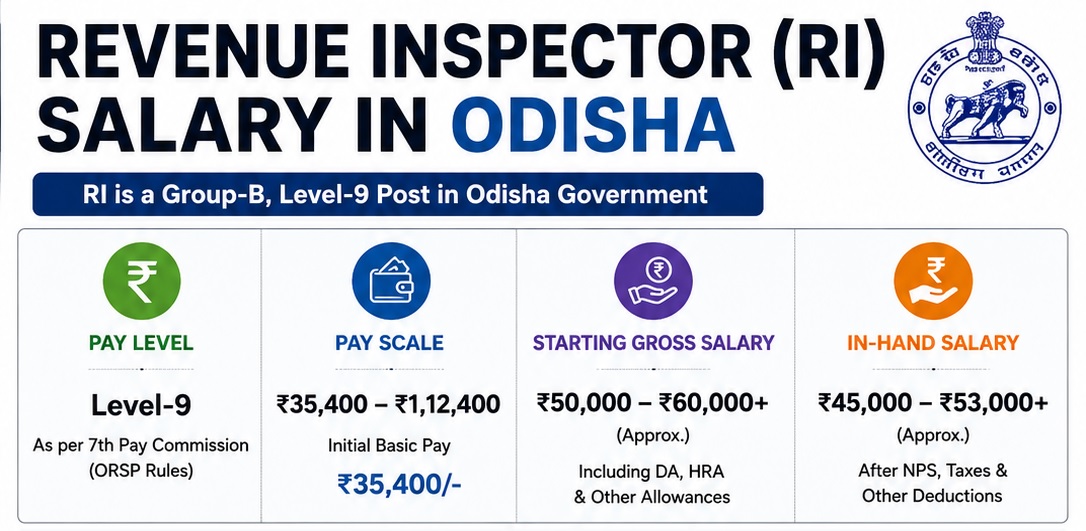
Let’s get to the number everyone wants to know. The Revenue Inspector post in Odisha falls under Pay Level 9 of the 7th Pay Commission Pay Matrix, which places the starting basic salary at ₹35,400 per month. This basic pay isn’t fixed forever — it increases over time through annual increments and further jumps significantly with each promotion, eventually going up to ₹1,12,400 at the higher end of the scale for someone who has spent many years in service and climbed the ranks.
It’s worth pausing here to clarify something that confuses a lot of first-time applicants: the ₹35,400 figure is the basic pay, not the amount that lands in your bank account. Government salaries in India are structured as basic pay plus a bunch of allowances, and those allowances often add a substantial chunk on top of the basic figure. So when people ask “what is the RI salary in Odisha,” the honest answer needs two numbers — the basic pay scale and the actual in-hand salary.
Basic Pay vs Gross Salary vs In-Hand Salary
These three terms get thrown around loosely, so here’s a quick breakdown of what each one means:
- Basic pay is the base figure fixed by the pay matrix — ₹35,400 for a newly recruited RI.
- Gross salary is the basic pay plus all applicable allowances (Dearness Allowance, House Rent Allowance, Travel Allowance, and so on) before any deductions.
- In-hand salary is what’s left after standard deductions like Provident Fund contributions, professional tax, and other applicable cuts.
For an entry-level RI in Odisha, the gross monthly salary — once allowances are added — typically works out to somewhere in the range of ₹54,000 to ₹55,000. After the usual deductions, the actual in-hand amount most new recruits can expect falls somewhere between ₹40,000 and ₹52,000 per month, depending on their posting location, applicable HRA slab, and a few other variables. This is a healthy starting salary by Odisha’s cost-of-living standards, especially for a Group C government post that doesn’t require a postgraduate degree.
Breaking Down the Allowances
The gap between basic pay and in-hand salary comes almost entirely from allowances, so it’s worth understanding what these are and why they matter.
Dearness Allowance (DA)
Dearness Allowance is meant to offset inflation and is revised periodically by the state government, usually twice a year. It is calculated as a percentage of basic pay, and because it gets revised regularly, an RI’s salary effectively increases even without a formal promotion, simply because DA rates climb over time. This is one of the quieter benefits of government employment — your purchasing power is at least partially protected against rising prices in a way that many private-sector salaries aren’t.
House Rent Allowance (HRA)
HRA depends on where the RI is posted. Postings in bigger towns or district headquarters generally attract a higher HRA slab compared to postings in smaller rural blocks, since the cost of renting accommodation varies quite a bit across Odisha. If an RI is provided government quarters, HRA may not apply at all, or may apply at a reduced rate.
Travel Allowance (TA)
Given that fieldwork is a core part of the job — visiting villages, verifying land boundaries, attending to disputes — Travel Allowance is a meaningful part of the compensation package. It’s meant to cover the cost of local travel that the role demands, which can add up given how much ground-level movement the job actually involves.
Other Benefits
Beyond DA, HRA, and TA, RIs in Odisha are also entitled to:
- Medical allowance or reimbursement for treatment
- Leave Travel Concession (LTC) for travel during approved leave
- Provident Fund contributions toward retirement savings
- Gratuity after completing the minimum qualifying service period
- Group insurance coverage under applicable state government schemes
None of these show up as a lump sum in a monthly salary slip in the way DA or HRA does, but they add real long-term value, particularly the retirement benefits, which matter a great deal in a country where pension security has become less common outside government jobs.
How RI Salary Compares to Related Posts
If you’re researching the RI post, you’ve probably also come across the Assistant Revenue Inspector (ARI) position, since OSSSC often recruits for both through the same Combined Recruitment Examination. It helps to understand where RI sits relative to ARI, because the two are frequently confused by first-time applicants.
RI vs ARI Salary
The ARI post sits just below RI in the departmental hierarchy and, correspondingly, in pay as well. While an RI starts at a basic pay of ₹35,400 under Pay Level 9, an Assistant Revenue Inspector typically starts lower, with reported monthly earnings in the range of ₹32,000 to ₹35,000, and a basic pay scale that begins around ₹29,200 under a lower pay level. ARIs work under the supervision of RIs and essentially serve as the bridge between the public and the revenue administration machinery at an even more grassroots level.
The good news for ARIs is that the position isn’t a dead end — with experience and by clearing departmental promotion exams, an ARI can move up to become an RI, and from there continue up the ladder toward Tahsildar and beyond. So many people who join as ARI treat it as the first rung of a longer climb rather than a final destination.
RI vs Tahsildar
It’s also useful to know what lies ahead if you stick with the revenue department long-term. The RI post is generally seen as a stepping stone toward becoming a Tahsildar, which is a considerably more senior administrative role with much greater authority, responsibility, and pay. This promotion isn’t automatic or quick — it typically requires years of service, a clean record, and often clearing departmental exams or fulfilling seniority-based criteria — but it does mean the RI position is not a ceiling. It is, for many, a launching point.
Factors That Influence an RI’s Actual Take-Home Pay
Two Revenue Inspectors with the same basic pay can end up with noticeably different in-hand salaries. Here’s what typically causes that variation:
Posting location plays a big role because HRA rates differ between urban, semi-urban, and rural postings. An RI posted in a district headquarters town will generally see a higher HRA component than one posted in a remote rural tahsil, even though their basic pay is identical.
Years of service matter enormously, since annual increments steadily push up the basic pay, and DA hikes compound that effect over time. An RI who has served for ten years will be earning considerably more than someone who just joined, even without a promotion in between.
Promotions obviously have the biggest impact. Moving from RI to a senior RI grade, and eventually toward Tahsildar, comes with a jump in pay level entirely, not just incremental raises within the same level.
Government-provided accommodation, if available, changes the equation slightly since HRA may not be paid in full (or at all) when quarters are provided, though this is offset by not having to pay rent out of pocket.
Career Growth and Promotion Path for an RI in Odisha
One of the most attractive things about the RI post isn’t just the starting salary — it’s what the job can turn into over a career. Odisha’s revenue department has a fairly well-defined promotion ladder, and RI is positioned right in the middle of it, which means there’s meaningful room to grow both upward and outward in terms of responsibility.
Someone who joins as an RI and performs well, accumulates the necessary seniority, and clears any required departmental assessments can realistically expect promotion first within revenue inspector grades and eventually toward Tahsildar, a significantly more senior post with wider administrative powers over an entire tahsil (a revenue sub-division). From there, further progression toward posts like Sub-Collector becomes possible for those who continue to perform well and put in the years.
This is a big part of why the RI post attracts so many applicants every recruitment cycle — it isn’t just a job, it’s an entry point into a long-term administrative career within the state government, with a clear (if gradual) path toward greater seniority, authority, and of course, salary.
Is RI a Good Career Choice in Odisha?
This is a fair question, and the honest answer is: it depends on what you’re looking for, but for a lot of people, yes, it genuinely is a solid choice. Here’s why so many candidates continue to compete for this post year after year.
Government job security in India remains hard to beat, and the RI post offers exactly that — a permanent, pensionable position that isn’t subject to the layoffs and market volatility that private-sector jobs often are. Combined with a starting in-hand salary that comfortably exceeds ₹40,000 a month in many cases, along with steady increments, periodic DA revisions, and a real promotion pathway, it adds up to a career that offers both financial stability and a sense of upward mobility.
There’s also a social dimension that shouldn’t be underestimated, especially in Odisha’s smaller towns and rural areas. The RI holds a position of local respect and administrative authority — people come to the RI’s office to resolve land disputes, get documents verified, and seek help during natural calamities. For candidates who want a role that combines fieldwork, public service, and government-level authority without needing to clear one of the more famously competitive All India exams, RI in Odisha hits a practical sweet spot.
That said, it’s worth being realistic about the flip side too. The job involves genuine fieldwork, sometimes in difficult terrain or during monsoon and cyclone season when disaster relief coordination becomes part of the workload. Postings in remote rural blocks can mean fewer urban conveniences, at least until a transfer or promotion moves you elsewhere. If you’re someone who strongly prefers desk-only work with minimal travel, this might not be the ideal fit — but for candidates comfortable with a mix of office and field responsibilities, it’s hard to find a Group C post in Odisha that offers this combination of pay, stability, and growth potential.
How to Apply for the RI Post in Odisha
For those seriously considering this path, recruitment for RI (and related posts like ARI) happens through the Odisha Sub-Ordinate Staff Selection Commission via its Combined Recruitment Examination. The general eligibility requires candidates to be graduates — typically in Arts, Science, Commerce, or equivalent fields — and to fall within the specified age bracket, which usually spans from around 20 to 42 years, though exact limits and relaxations for reserved categories should always be confirmed against the latest official notification.
The selection process generally unfolds in stages: a preliminary written examination to filter down the large applicant pool, followed by a mains examination that tests subject knowledge more rigorously, and finally a skill test along with document verification for those who clear the earlier stages. Given how popular this post is, competition tends to be intense, so candidates typically prepare using previous years’ question papers and stay updated through the OSSSC’s official notifications and local job portals, since exam dates, vacancy numbers, and application windows can shift from one recruitment cycle to the next.
Conclusion
To sum it all up, the RI salary in Odisha starts with a basic pay of ₹35,400 per month under Pay Level 9 of the 7th Pay Commission, and once you factor in Dearness Allowance, House Rent Allowance, Travel Allowance, and other benefits, the actual in-hand salary for most new recruits lands somewhere between ₹40,000 and ₹52,000 a month. Add to that a genuine promotion pathway toward Tahsildar and beyond, solid retirement benefits, and the kind of job security that’s increasingly rare, and it’s easy to see why this remains one of the most sought-after Group C government posts in the state.
If you’re weighing this career against other options, the key things to remember are that the pay is competitive for a graduate-level government post, the allowances meaningfully boost your take-home salary beyond the basic figure, and the long-term growth potential within the revenue department is real rather than just a formality. Whether the fieldwork and rural postings suit your preferences is really the deciding factor at that point, since the financial and career-growth case for RI in Odisha is fairly strong on its own merits.
Frequently Asked Questions
1. What is the starting salary of an RI in Odisha? The starting basic salary is ₹35,400 per month under Pay Level 9 of the 7th Pay Commission Pay Matrix. Once allowances like DA and HRA are added, the gross salary comes to roughly ₹54,000–₹55,000, with in-hand pay typically falling between ₹40,000 and ₹52,000 per month.
2. Is RI a permanent government job in Odisha? Yes. RI is a permanent, pensionable Group C post under the Odisha Revenue and Disaster Management Department, recruited through the OSSSC Combined Recruitment Examination.
3. What is the difference between RI and ARI salary in Odisha? RI starts at a basic pay of ₹35,400 under Pay Level 9, while ARI typically starts lower, around ₹29,200 to ₹35,000 per month depending on the source and pay level applied. ARI is a junior post that reports to the RI and can eventually be promoted to RI with experience.
4. Can an RI in Odisha get promoted to Tahsildar? Yes, with sufficient years of service, a good service record, and clearing departmental promotion requirements, an RI can be promoted up the revenue hierarchy, eventually reaching posts like Tahsildar and, further along, Sub-Collector.
5. What allowances does an RI in Odisha receive besides basic pay? RIs receive Dearness Allowance, House Rent Allowance, Travel Allowance, medical benefits, Leave Travel Concession, Provident Fund contributions, gratuity, and group insurance coverage, all of which add up on top of the basic pay.
6. What qualifications are needed to become an RI in Odisha? Candidates generally need a graduate degree in Arts, Science, Commerce, or an equivalent field, and must fall within the specified age limit (typically around 20 to 42 years, with relaxations for reserved categories) at the time of applying through OSSSC.
About the Author